What you're actually buying
A pre-rinse spray head lives a harder life than almost any other fitting in a kitchen. It sits in steam and detergent mist for hours, gets dropped on sink edges, gets pulled sideways by its own hose, and is expected to work every shift for years. Nothing about that is exotic — but it does mean the parts that decide its life are boring ones: what the metal is, whether the wearing parts can be replaced, how it seals, how the spray is held on, and whether the thread is the one your hose already has.
Here is what to look for on each, in the order that a failure will actually reach you.
The metal, named specifically
"Stainless steel body" is on almost every listing in this category, and it is worth almost nothing as a claim, because it doesn't say which stainless. What you want to see is a grade stated outright — 304 stainless for the metal parts — because that is a specific alloy with a known behaviour around water, chlorides and the cleaning chemicals a dish pit throws at it. A listing that says "premium stainless" and stops there is telling you that the spec sheet has a hole in it.
Two honest notes. First, the grade only means anything if it covers the parts that see water — body, handle, and the metal in the spray face — not just an outer shell. Second, we can only speak for our own: our metal parts are 304 stainless steel, as marked on our packaging. We can't verify what is inside anyone else's product, and you shouldn't take a seller's word for it either. Ask for the grade in writing.
The parts you are allowed to replace
Every head needs a washer or a filter screen sooner or later. The difference between a head that lasts years and a head that gets binned is whether those parts can be changed on their own, and whether you can get them.
The filter screen inside the inlet is the clearest test. It sits first in line, so it collects what would otherwise reach the spray face — and on a head that is built to be serviced it simply lifts out and goes back in. The same goes for the seal where the head meets the hose: it should be a washer you can replace in a minute, not a bonded joint that fails with the whole casting.
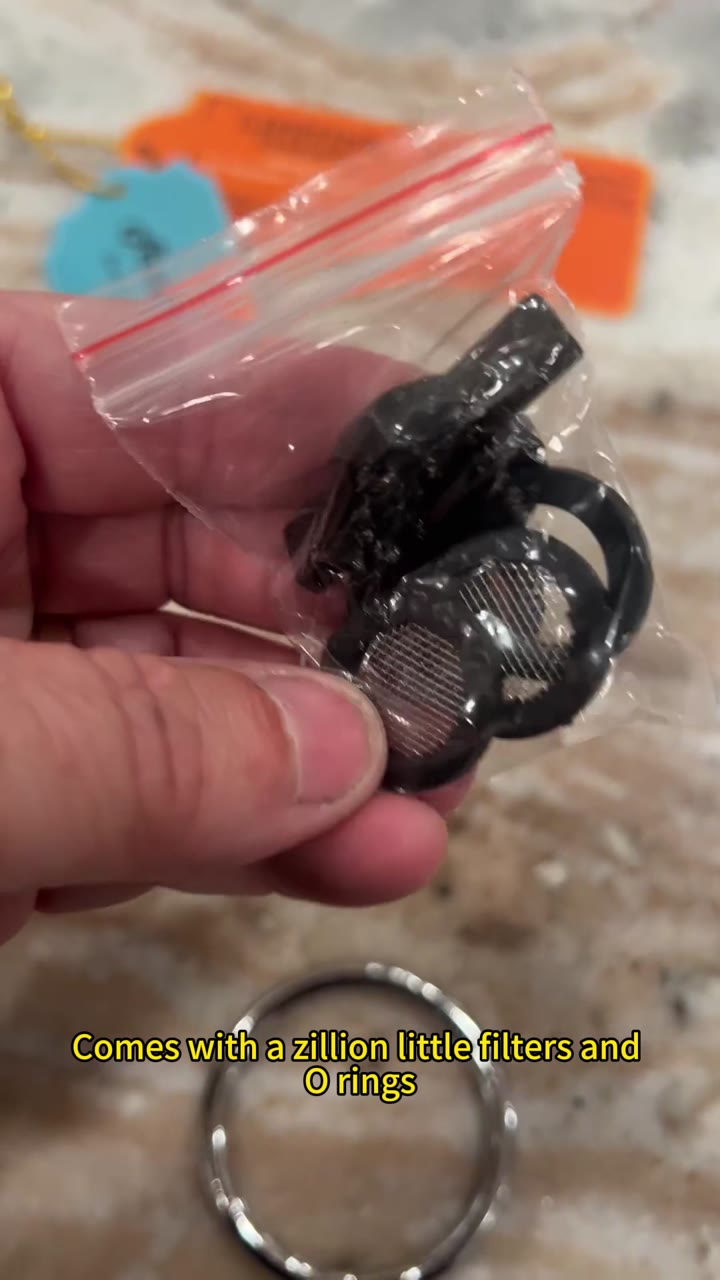
Which is why a small bag in the box matters more than it looks. Ours ships with spare filters and washers, so a lost washer is a five-minute annoyance rather than an order.
How it seals — and why that decides the tape question
A pre-rinse head does not seal on its threads. It seals on a washer that is compressed at the face of the joint; the threads only hold the two parts together. That single fact explains two things you run into on these fittings: the tape habit, and the leak that follows it.
Because the seal is a gasket, thread tape does nothing useful here. Worse, shreds of it break off and travel downstream into the smallest openings in the system, which are the holes in your spray face — you fix a leak that wasn't there and create a blockage that is. The full reasoning, and the thread types where tape genuinely does belong, is on the remove and replace page.
The other half of this detail is what you find when the head comes off: very often the old washer or a flow restrictor is still sitting inside the hose end. Screw a new head down on top of it and it will never seat. Check inside the hose end before fitting anything.
The latch that holds the spray on
This is the detail that decides what the end of a shift feels like. A conventional pre-rinse valve only sprays while the lever is squeezed — so on a long rinse, the hand holding it is working the whole time. Multiply that across a dish pit shift and the complaint it produces is about the hand, not about flow rate.
A one-hand clip changes it. The lever latches on, the spray runs without your thumb holding it, and it releases the same way with one thumb rather than two hands. On a spec sheet this shows up as a "continuous spray clip" or a "hold-open clip" — if the listing doesn't mention one, assume there isn't one.
The thread — check before anything else
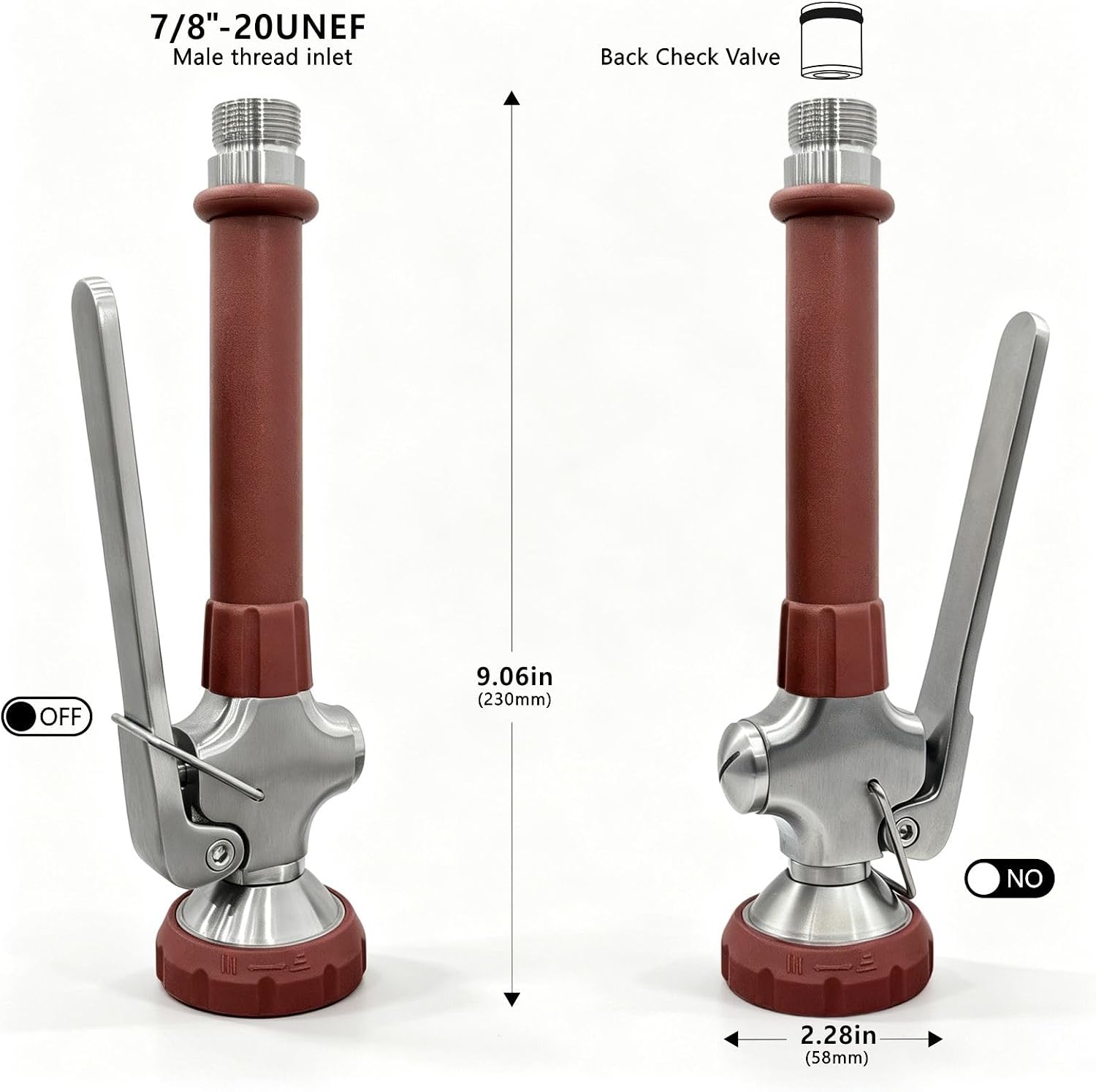
This one is listed last and matters most, because a head with perfect construction and the wrong thread is a return. Commercial pre-rinse assemblies in the US use a fine, straight thread, and the head has to match it exactly. It is a nominal 7/8”-20 UNEF inlet on ours, and the drawing below is the one we publish for it — including the note that the inlet is male.
Household plumbing is a different world entirely, and no adapter bridges the two in a way you should trust under a commercial sink. If you don't know your thread, the sixty-second checker and a ruler on the hose end settle it before you order, which is the only moment when it is cheap to be wrong.
Five lines to look for on any listing
| # | What to look for | Why it matters |
|---|---|---|
| 1 | A named stainless grade (304) for the metal parts | "Stainless" alone doesn't say which alloy, or which parts |
| 2 | Replaceable filter screen and a serviceable seal | Decides whether the head is repaired or binned at the first drip |
| 3 | Spare filters and washers in the box | A consumable you can't source turns into a whole new head |
| 4 | A continuous-spray clip, released with one thumb | The difference between holding a lever all shift and not |
| 5 | The thread, stated as a standard, with a dimensioned drawing | A wrong thread is the one fault no construction quality can rescue |
If a listing can't answer all five, that's information in itself. It doesn't mean the product is bad; it means you'd be buying it on the strength of the photo.
What we won't claim
- We won't tell you a grade of steel is a warranty. Materials are what make a service life possible, not what guarantees one. How a head is used and maintained is at least half the outcome.
- We won't put numbers on failure rates or durability. We don't have maintenance records from installed kitchens, so any hour count or percentage would be invented. The five details above are what we build to, not a measured failure curve.
- We won't claim our construction fixes a maintenance problem. If your current spray has gone weak and ragged, the first move is the free vinegar soak, not a new head — and when rebuilding genuinely stops paying, that page lays out the arithmetic.
- We won't quote a flow figure we can't source. Flow limits for commercial pre-rinse valves are set by federal rules; the GPM guide explains how the rating works rather than flattering it.
- We can't audit anyone else's head. We can tell you what to ask a seller for. What arrives in the box is between you and them.
The short version
Look past the glossy photo. Ask what stainless grade the metal parts are, whether the filter screen and seal can be replaced on their own, whether spares come in the box, whether the lever latches on for continuous spray, and what the thread is stated as. Five questions, no tools, and they tell you more than any flow number on the page. If the head you already own gets all five right, it is worth maintaining rather than replacing.
Want a second opinion on a listing you're looking at? Send it over — we answer with the questions we'd ask, not a sales pitch.