The dilemma is built into the design
A pre-rinse valve exists to do one violent thing: break food loose with a thin, fast jet of water. That works brilliantly on a sheet pan with baked-on BBQ sauce. Then the same valve meets a colander of basil, a stack of china with a light dusting, or the inside of a stockpot you just want to wet down — and the only thing it can offer is more of the same blast.
This isn't an anecdote of ours; it shows up in utility research. A water-saving pilot study in Ontario, Canada, which swapped hundreds of kitchen spray valves, kept running into the same wall: at some sites, staff complained the new valves "caused excessive spraying and splashing" and asked for the old ones back; at another site, a low-flow valve was too gentle to clean lettuce-shredding equipment, so the kitchen requested its original, thirstier valve be reinstalled. The study's own conclusion was that spray valves behave differently at different water pressures — but underneath that is a simpler truth: a single pattern is a compromise, and some kitchens lose on one side of it.
The other side of the compromise is water. Old valves ran 2–3 gallons a minute; modern codes cap them near 1.28 GPM. But if you take the flow away from a single-pattern valve, the jet weakens and the pan scrub doubles. Kitchens end up choosing between a valve that wastes hot water and one that wastes labor.
What kitchens actually do about it
Ask anyone who runs a dish pit and you'll hear the same quiet adaptations. None of them are wrong. All of them are expensive in small ways, every shift:
- Work the plate farther from the sink floor, so the jet's energy dies in the air before it rebounds off china. Slower, and the rebound still lands somewhere.
- Pre-soak everything longer, letting water do at hour one what the jet was too blunt to do in ten seconds. Racks queue up; the machine waits.
- Angle the head and feather the trigger, tapping on-off-on to fake a gentler rinse. It works, and it also wears out wrists — which is its own article.
- Keep a second faucet or a garden-style sprayer for the delicate jobs. Two fixtures, twice the cost, half the counter.
Every one of these workarounds exists because the tool offers a single answer to a job that comes in two shapes: break it loose and finish it clean.
Two patterns, one twist — what that actually changes
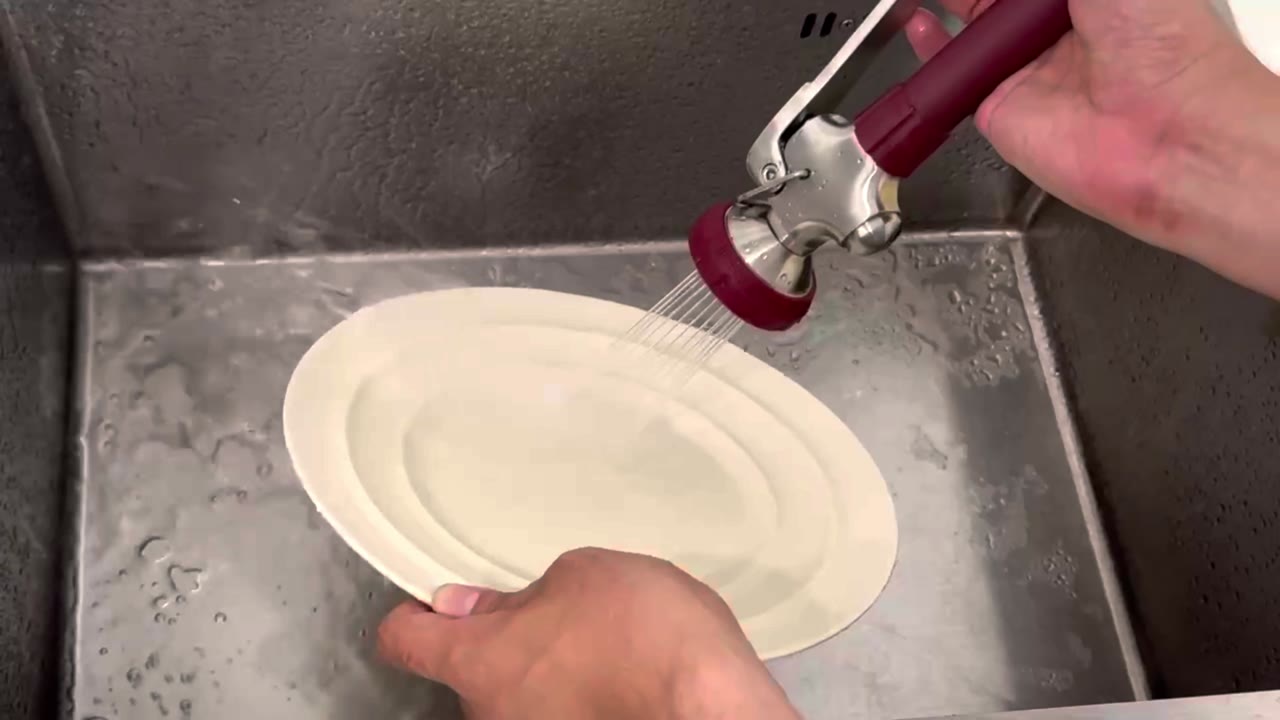
Our head carries two spray faces, and you switch between them by rotating the head itself — one turn, wet hands, no tools, nothing to disassemble. One setting throws a shower pattern: a tight, high-powered ring of jets that hits like the pre-rinse pattern kitchens know, made to strip and knock down. The other lays down a knife pattern: a wide, flat, fan-like sheet that covers a whole plate or a colander in one pass — the finishing rinse, produce, or wetting a pan down without blasting last night's label off the bottom.
The switch is mechanical and it is fast. Mid-task, mid-rinse, you can rotate from shower to knife in the time it takes to turn a plate over — which is exactly the moment a single-pattern valve forces you to choose between blasting the china and scrubbing the pan.
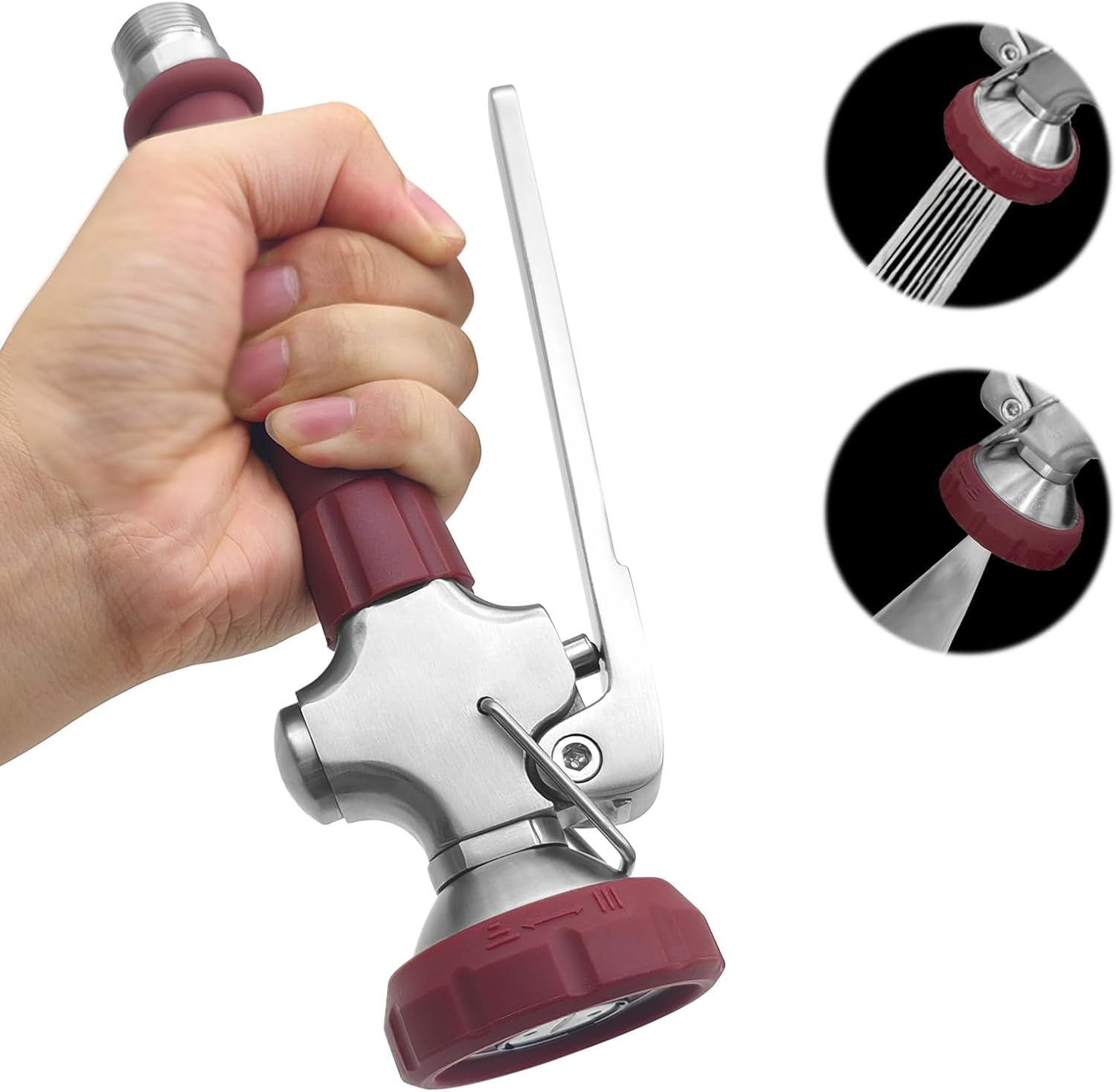
In practice the day splits the way it always should have: shower for the pans, knife for everything the blast used to punish. And because both patterns share one valve body, the kitchen doesn't add a second fixture or re-plumb anything — the head threads onto the standard 7/8”-20 UNEF hose end that American pre-rinse units already have. If you're not sure about your thread, run the thread checker first; it's faster than a return.
There's a third piece, and honestly it might matter more day to day than the spray patterns: a snap ring that holds the spray on without your thumb. Conventional valves demand continuous lever pressure, which is why the dish pit goes home with an aching hand. Ours lets you latch the spray on for the long rinse and release it the same way. Small mechanism; it changes the shape of an eight-hour shift.
What we know, and what we won't claim
We've been developing this head for several years and went through more revisions than we care to count — the spray faces, the rotating head, seal materials, the balance of the handle in a wet hand. We're proud of the result. That is exactly why we'll keep this section short and factual rather than loud:
- It is a commercial part. 7/8”-20 UNEF, for pre-rinse assemblies. It does not fit household faucets or NPT threads, and we won't pretend otherwise.
- Two modes don't fix a clogged face. If your spray has gone weak and ragged, the first move is the free vinegar soak, not a new head — even when the new head is ours.
- We don't quote performance numbers we can't back. Flow limits for commercial pre-rinse valves are set by federal rules, and we explain how they work in our GPM guide rather than inventing a flattering number.
- It's stainless steel and POM, backed by a lifetime warranty card — and if something goes wrong, the support email is printed on it: [email protected].
The short version
A single spray pattern forces a choice: strong enough to strip pans, or gentle enough not to wreck everything else. Kitchens resolve it with soaked racks, tired wrists, and a second sprayer. Two patterns on one head, switched by rotating the head — shower to break it loose, knife to finish — plus a snap ring that holds the spray on, remove the choice instead of managing it.
Check your thread before ordering — the sixty-second checker is faster than a return.