What connects to what
A commercial pre-rinse spray head screws onto a hose end threaded 7/8”-20 UNEF — the US standard on pre-rinse assemblies. A home faucet does not have that connection at all. What it has is an aerator mount — a 1/2” NPT or G 1/2” thread on many models, or a proprietary quick-connect on pull-downs — and that port was built to hold a few grams of diffuser screen, not to feed a hose. There is no adapter between the two, and the rest of this page is the structural reason why.
Two ports, two completely different jobs
| Commercial pre-rinse connection | Home faucet outlet | |
|---|---|---|
| The port's actual job | A hose joint that gets opened whenever heads are swapped, and carries a swinging metal head all shift | A mount for an aerator — a few grams of screen that never move and are never pulled |
| The thread | 7/8”-20 UNEF: parallel, ~22.2 mm, 20 threads per inch | 1/2” NPT (tapered, 14 TPI), G 1/2” BSPP, or a proprietary quick-connect |
| How it seals | On a face — a flat washer or O-ring inside the nut | On the threads themselves (NPT is tapered and seals by interference) |
| What hangs off it | A hose, a spring riser above it, and a head you steer by hand | Nothing. By design. |
Why "just use an adapter" can't work
- The numbers don't line up. A 7/8”-20 UNEF male thread measures about 22.2 mm across; a 1/2” NPT male is about 21.2 mm — one millimetre apart, which is exactly why the two get confused — but one is cut at 20 threads per inch and the other at 14, and the NPT tapers. The threads simply never engage. G 1/2” is parallel like ours but sits at 21.0 mm and 14 TPI. Bridging any of these takes a machined one-off, not a catalog part: nothing stocked at hardware stores or industrial suppliers connects them. We walk through the four threads you'll actually meet in the thread & fit guide.
- Even a perfect thread match would hang a hose off a part built to hold an aerator. The aerator housing on a home spout is a thin collar engaged by a few fine threads, sized for a part that weighs almost nothing and is never tugged. A pre-rinse hose with a metal head on the end is a bending load that port was never designed to carry — and on pull-down faucets the "sprayer port" is usually a proprietary quick-connect with no usable thread at all. The failure mode isn't a slow drip; it's a spout that gives way.
- The sealing philosophies don't mix — and neither does the warranty. A parallel thread seals on a washer face; a tapered thread seals on its own flanks. Force one onto the other and you get a joint sealed by hope and tape. And once a faucet has been modified to accept something it was never meant to take, whatever happens next is covered by nobody — not the faucet maker, and not us.
"Commercial-style" faucets are not commercial
This is the detail that sends people down the wrong path. Spring-coil pull-down faucets sold for homes copy the silhouette of a pre-rinse station — tall spring, pull-down head, the words "commercial-style" right in the listing. They are residential products. Underneath the costume they carry a G 1/2” thread, and a commercial head will not thread onto them. The look is styling; the thread is the contract. Ours is 7/8”-20 UNEF, and nothing about a resemblance changes that.
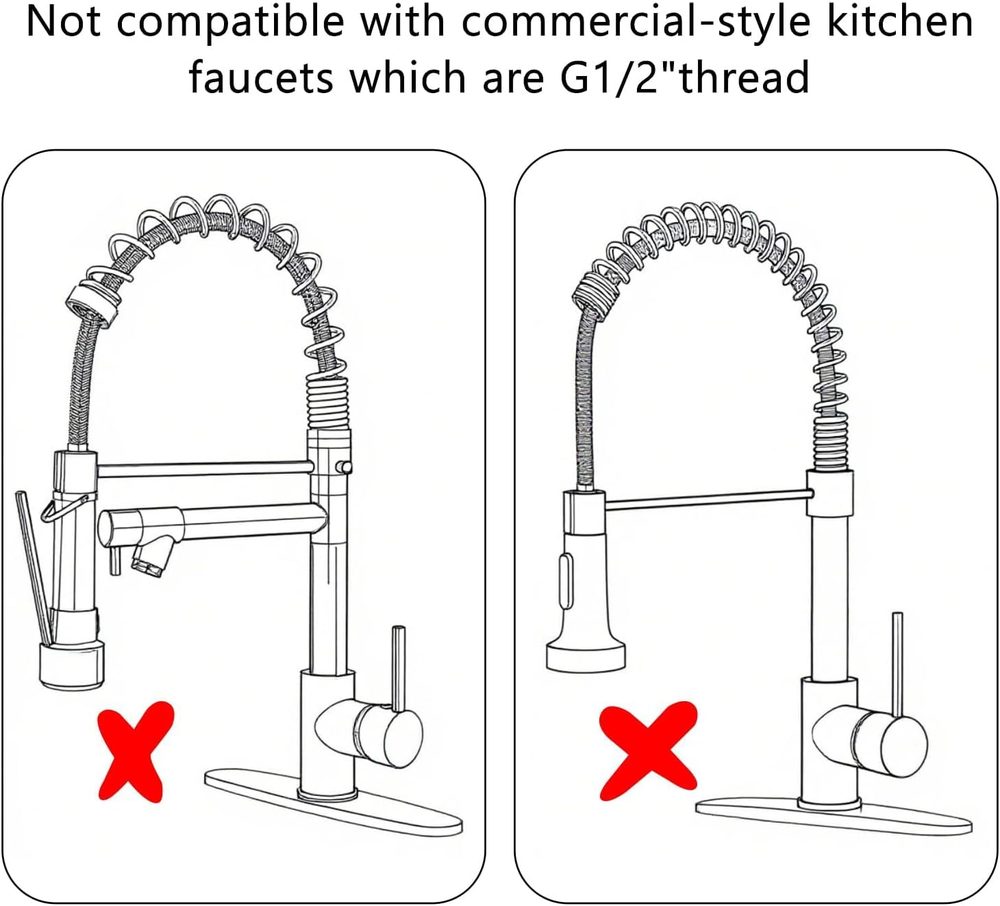
Whichever one brought you here, the honest answer
- "I just want a stronger sprayer at home." The part you want is your faucet maker's own replacement spray head, matched to your faucet's model number — it exists, it is made for your exact port, and it costs a fraction of a commercial head. That is not a product we carry, and we would rather point you there than sell you a head you'd be shipping back.
- "I run a small kitchen and want pre-rinse power." Then the head is not the part you're missing — a pre-rinse is a station: riser, spring, hose and a mixing valve mounted on the sink deck or wall. The head is only the last inch of that system. If your sink currently has a household-style faucet on it, the faucet is the wrong part, not the head. Fit the station first; the head screws on from there.
- "I already bought one and it won't thread on." Stop there. Don't force it, don't build the joint out of tape, and don't spend an evening hunting for an adapter — there isn't one. Measure the connection you actually have, and if it isn't 7/8”-20 UNEF, this head is the wrong part for your setup and the return window is exactly what it's for.
The thirty-second check
- Find the port you're actually buying for — the end of the hose or spout the new head must thread onto, not the faucet's brand or look.
- Measure the outside diameter and count the threads per inch. A $15 caliper settles it; if you don't have one, the photos in the fit guide show you what each thread looks like.
- Read the result: 7/8”-20 UNEF → our heads fit. 3/4”-14 → the Brass Chrome model has that as its optional end thread. Anything else → wrong aisle, and no purchase of ours fixes it. Or run the 60-second thread checker and let the verdict do the reading.
What we won't claim
- This page is designed to lose us a sale. If you're shopping for a home kitchen, our head is the wrong product for you and we would rather say it here than read it in a return.
- We won't pretend our adapters change this. The 38” and 45” assemblies ship with three adapters — for a garden hose and for commercial spouts. None of them adapts a home faucet, and we print that on the fit guide so nobody finds out from the box.
- We won't tell you where there's a will there's a way. A forced thread mismatch ends in a leak, a damaged faucet, or both — and after a modification, no warranty on earth covers the outcome.
- What we will do: if you describe your connection in three lines here, we will tell you straight what it is — including "that's a home faucet, and this is not the part you need."
The short version
A pre-rinse head is not a large faucet attachment — it is the working end of a commercial station, and it speaks 7/8”-20 UNEF while your home faucet speaks aerator. Different thread, different load, different seal. There's no adapter because there can't be one. Home use: buy the replacement part from your faucet's maker. Commercial sink: fit the station, then the head. And if you're not sure which one you've got — measure first, order second.
Actually fitting a commercial pre-rinse hose? See the full lineup — heads, hoses and the adapters that do exist.